My Tenant's Cleaner Started a Fire — What My Insurance Actually Covered
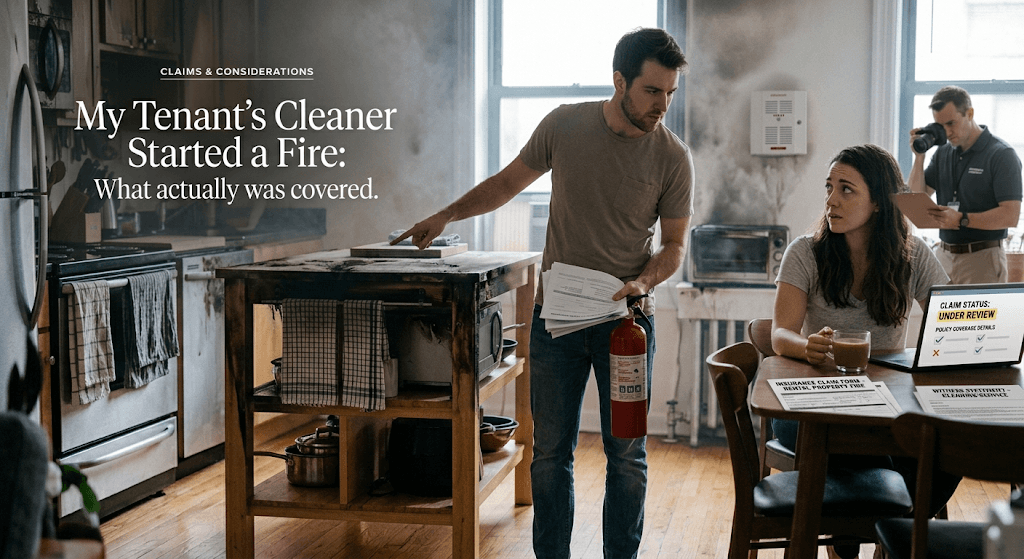
A composite, illustrative scenario about a tenant's independently hired cleaner causing a small kitchen fire, and what it reveals about the gap between landlord, tenant, and cleaner insurance.
This is a composite scenario built from the kind of disputes that show up in landlord forums and property manager discussions, not a documented case tied to one specific policy, insurer, or claim. It's worth walking through anyway, because the coverage question it raises is real even when the exact story is invented: a tenant hires their own cleaner, something goes wrong, and everyone involved assumes someone else's insurance will pay for it.
Key Takeaways
- A landlord's building insurance usually covers fire or structural damage regardless of who caused it, but that's rarely the end of the story.
- Insurers can try to recover their payout from whoever's negligence caused the damage. This is called subrogation, and it can pull in the tenant, the cleaner, or both.
- A tenant's renters or contents insurance typically protects the tenant's own belongings and personal liability. It doesn't automatically cover damage a third party causes to the landlord's property.
- An independently hired cleaner with no liability insurance often leaves no one to pursue for reimbursement, which can push the cost back toward the tenant or the landlord anyway.
- Lease terms about disclosing regular service providers, and confirming your own policy's third-party wording before anything happens, are the two most useful things a landlord can do in advance.
A Composite Scenario: The Cleaner, the Stove, and the Aftermath
In this illustrative case, the tenant found a cleaner on their own, someone from a classified ad, not anyone the landlord selected or knew about. The cleaner came in for a routine visit, put something on the stove to heat while tidying elsewhere in the kitchen, and got pulled into another task long enough for a pan of oil to catch fire. The flames reached a cabinet before the tenant, home at the time, managed to put it out.
No one was hurt. The damage was still significant: charred cabinetry, a ruined section of countertop, and smoke residue that spread through the ventilation into rooms the fire never touched, requiring repainting and duct cleaning across the unit. The landlord's first move was to call their building insurer, assuming that a fire is exactly what that policy exists for.
Why "It's a Fire, So Insurance Covers It" Isn't the Full Answer
The building insurance side of that assumption usually holds up. Landlord policies typically cover fire damage to the structure and to landlord-owned fixtures like cabinetry, regardless of who or what started the fire. That part tends to be straightforward.
What's less straightforward is what happens after the insurer pays out. Many policies include a right of subrogation, meaning the insurer can try to recover its costs from whoever was actually negligent, if that party can be identified and has assets or insurance to collect from. So "covered" and "who ultimately bears the cost" turn out to be two different questions, and the second one is where this gets complicated.
It's also worth separating structure from contents. Anything the tenant owned that was damaged, whether by fire or smoke, generally falls outside the landlord's building policy entirely. That's the tenant's own contents insurance to claim on, and only if the tenant has one.
Whose Policy Is Actually Supposed to Pay
The tenant's angle is the first place people look, and it's murkier than it sounds. Many renters or contents policies include personal liability coverage, but that's built around the tenant's own negligence. Whether it extends to damage caused by someone the tenant invited in, like a cleaner, depends heavily on the policy wording and on what the lease says about the tenant being responsible for guests and service providers they bring onto the property. In some cases the tenant can end up on the hook precisely because the lease made them responsible for anyone they let in.
The cleaner's own liability insurance, if it exists, is often the cleanest path, since the cleaner's negligence is what actually caused the fire. A cleaner operating as an insured business would typically have public liability cover built for exactly this kind of incident. The problem is that a lot of informally hired, individual cleaners, the kind found through a classified ad or a word-of-mouth referral with no contract, carry no liability insurance at all. When that's the case, there's simply no policy to make a claim against, no matter how clearly the fault sits with them.
That tends to leave the landlord's own building policy as the practical backstop, since it's the one relationship the landlord already has and the one that pays out fastest. But a claim can still raise the landlord's premiums going forward, and the insurer's attempt to recover costs from the tenant or cleaner afterward can take months and may not fully succeed, especially if neither has insurance or significant assets.
What Landlords Can Actually Do About This
None of this is about blocking tenants from hiring their own help. It's about not finding out where the gaps are after something has already burned.
- Add a lease clause requiring tenants to disclose regular non-tenant occupants and recurring service providers, cleaners and caregivers included, who have routine access to the unit.
- Encourage, or where locally enforceable require, that any cleaner a tenant hires directly carries liability insurance, and ask for basic confirmation of it.
- Call your own insurer before anything happens and ask specifically how the policy treats damage caused by a third party the tenant brought in, not just damage caused by the tenant. Wording on this varies a lot between insurers and even between policies from the same insurer.
- Keep a paper trail: the lease language on guests and service providers, any tenant notifications about hired help, and written confirmation from your insurer on how third-party damage is handled.
This is part of why some landlords and tenants lean toward a marketplace like DORIXÉ for cleaning services, where cleaners are vetted rather than found through an unverified, informal arrangement. That's not a substitute for checking your own coverage. It just removes one layer of uncertainty about who's actually shown up in the property.
The Bottom Line
The honest answer to "am I covered if my tenant's cleaner causes damage" is that it depends on your specific policy, your tenant's policy, whether the cleaner had any insurance of their own, and how your local law treats liability for third parties a tenant invites in. This article is general education, not legal or insurance advice for your situation. If you're a landlord, the useful step isn't worrying about it. It's calling your insurer now, asking the third-party question directly, and putting the answer in writing before you need it.
Comments (0)
Sign in to leave a comment.
No comments yet — be the first!