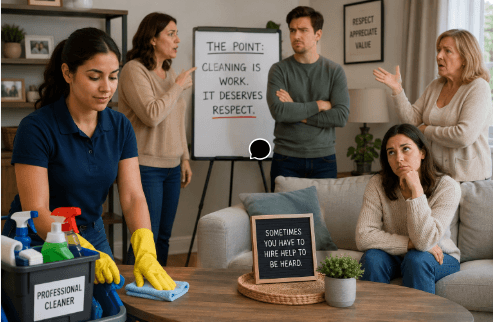
Hiring a Cleaner to Prove a Point: When Family Drama Meets Household Chores
Sometimes booking a cleaner after a fight about mess is a smart, practical move. Sometimes it's a scoreboard. Here's how to tell the difference before you swipe the card.
The Booking That Comes Right After the Fight
You know the pattern even if you've never named it. Someone, a partner, a parent, a mother-in-law visiting for the weekend, says something pointed about the state of your home. An hour later, you're on a cleaning app booking the most thorough service available. The house gets spotless. The comment never really goes away.
This is more common than anyone admits out loud, and it isn't automatically a bad thing. Hiring a cleaner after a criticism can be a completely reasonable decision that happens to also end an argument. It can also be a move in a fight that was never about the dust in the first place. The trouble is that both versions look identical from the outside, and often from the inside too.
What a Clean House Actually Proves
A clean house proves the house is clean. That's it. It doesn't prove you were right, that the criticism was unfair, or that the relationship issue underneath it has been resolved. If the booking is meant to do any of that extra work, it's going to disappoint you, because a service can't settle an argument about respect, fairness, or who gets to have opinions about your home.
That gap between what the cleaning fixes and what the fight was actually about is where most of the frustration lives. You did the thing. The complaint stops for a week. Then it comes back in a different shape, because the original issue was never really the crumbs on the counter.
Two People, Same Booking, Different Reasons
Picture two people making the identical purchase. The first works long hours, has genuinely fallen behind on housework, and books a cleaner because it's the sensible fix for a real problem, regardless of who said what. The criticism was just the nudge that finally got them to act on something they'd been meaning to sort out anyway.
The second person isn't behind on anything in particular. The house is fine by their own standards. But a parent or partner keeps bringing up cleanliness as a stand-in for a bigger complaint, maybe about control, maybe about feeling unappreciated, maybe about who gets to set the standard in a shared home. Booking a cleaner here isn't solving a mess problem. It's a receipt, something to produce the next time the subject comes up. "See? I handled it."
Both people end up with a clean house. Only one of them has actually fixed anything.
How to Tell Which One You're In
The honest way to check is to notice what you're feeling when you make the booking, not what you're saying out loud.
- Were you already thinking about hiring help before the comment landed, or did the idea appear the moment you got criticized?
- Do you feel relieved once it's booked, or do you feel like you've won something?
- If the same person criticized something else next month, would you expect the mood to actually improve, or just move to a new target?
- Could you say, honestly, "I did this for me," or is the real sentence closer to "I did this so you'd stop"?
If the answers point toward relief and a genuine backlog of housework, you're probably in the first situation: a practical fix that happens to have a side benefit. If they point toward vindication and a pattern that keeps shifting targets, you're in the second one, and the cleaner is a workaround for a conversation you're avoiding.
A clean floor can't settle an argument about being taken for granted. Only a conversation can do that.
If It's Really About the Argument
When the cleaning was never the real issue, the fix has to happen somewhere else, in an actual conversation about what the criticism is really carrying. That might be a partner who equates a tidy home with being cared about. It might be a parent who uses housekeeping as one of the few areas where they still feel entitled to an opinion about your life. Naming that directly, calmly, and without using the clean house as evidence in your favor, is the part that actually changes the pattern. Otherwise you're just buying quiet until the next inspection.
If It's Really About the Mess
Sometimes the criticism, however badly delivered, was pointing at something true: the house had gotten away from you, and nobody had gotten around to fixing it. In that case, hiring help is just good household management, and you don't owe anyone an apology for the timing. A recurring cleaning arrangement can even take the whole subject off the table permanently, which is worth something on its own. That's the kind of situation where a marketplace like DORIXÉ is genuinely useful, not as a statement to anyone, but as a standing solution to a chore that had stopped fitting into your week.
The Difference That Actually Matters
The service itself is neutral. What determines whether hiring a cleaner helps or just delays the same fight is whether you're solving the problem the criticism named, or trying to win an argument the criticism was standing in for. Get honest about which one you're doing before you book, and you'll know whether you need a cleaner, a conversation, or both.
Comments (0)
Sign in to leave a comment.
No comments yet — be the first!